
Stop Confusing Demos with POCs — Your Pipeline Depends on It

There is a conversation I have had dozens of times with partners across the field. It usually starts with some variation of: "We have been in a POC with this prospect for four months and it's just... stalled."
Every time, when we dig into what actually happened, the answer is the same. The POC was never really a POC. It was a feature demonstration dressed up in a lab environment, handed to a customer who wasn't ready for it — and nobody agreed on what "done" even meant.
This is what kills pipelines. Not the competition, not price, not features. It's the blurry line between a Demo and a POC, and what happens when you cross it at the wrong moment.
Let me share how the best partners in our ecosystem think about this — and what separates the ones who close in two weeks from the ones still spinning in technical validation six months later.
The Golden Rule: Know Which Tool You're Holding
Here's the simplest way I know to frame it.
A Demo answers the question: Can this solution do what I need?
A POC answers the question: Does this solution actually work — in MY environment, at MY scale, with MY team?
These are fundamentally different questions. And they require fundamentally different approaches.
The Demo is your movie trailer. It's high energy, it shows the best moments and it's designed to make the CISO lean forward and say, "I want to see more." The POC is the test drive — it's about reality, specificity and proof.
The trap most partners fall into? They try to test drive a car before the customer even likes the brand. You end up burning your engineering resources on a customer who was never emotionally bought in to begin with. Or worse, you run a six-month open-ended "POC" that is really just a long, expensive demo.
Respect the boundary between showing what's possible and proving what's practical. Everything else flows from there.
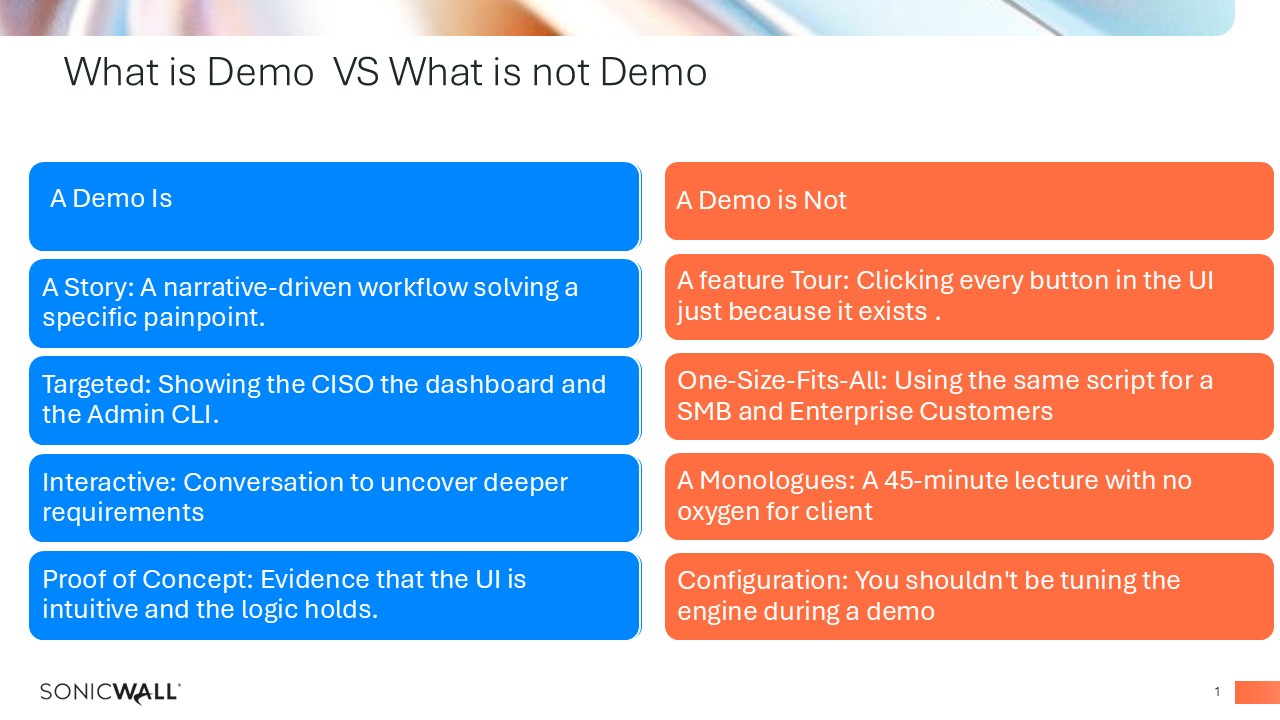
The Demo: It's a Story, Not a Feature Tour
.jpeg)
Let's talk about the single biggest deal-killer in a demo: the feature dump.
You know what it sounds like. "And here's the settings menu. And here's the reporting tab. And if you click here, you can see..."
By the time you get to the third tab, you've lost the room. The CISO is checking their phone. The security architect is mentally drafting their objection email.
A great demo is a story. It has a protagonist (the customer's team), a villain (the threat they're worried about) and a resolution (your solution catching or stopping it).
If you're presenting to a CISO, show them the 3 a.m. view — how do they know they're safe when something goes wrong in the middle of the night? If you're talking to a SOC analyst, show them specifically how they get two hours back in their day. Make it personal, make it their world.
A few things that separate winning demos from forgettable ones:
Lead with the payoff. Use the "last thing first" method — show the most impactful moment (the executive dashboard, the blocked attack, the threat caught in real time) in the first five minutes. Don't make them wait 30 minutes for the "big reveal." Start with the wow.
Contextualize everything. Don't just show a blocked alert. Tell the story behind it: "This represents a lateral movement attempt that would have bypassed your legacy NGFW." Context creates urgency. Alerts without context are just noise.
Follow the customer, not your script. Only go deep into a feature if the customer asks. This is what I call the double-click rule. Keep the high-level flow smooth. If a feature doesn't solve a specific pain they've mentioned, skip it. Leave the oxygen in the room for their questions.
Be honest about your environment. Use a canned or lab environment for reliability, but be ready to go live. Customers respect partners who can demo live — it signals confidence in the product and credibility in the relationship.
The POC: You're the Project Manager Now
If the demo went well, you've earned the right to a POC. Now the work really begins — and most of it happens before you deploy a single agent.
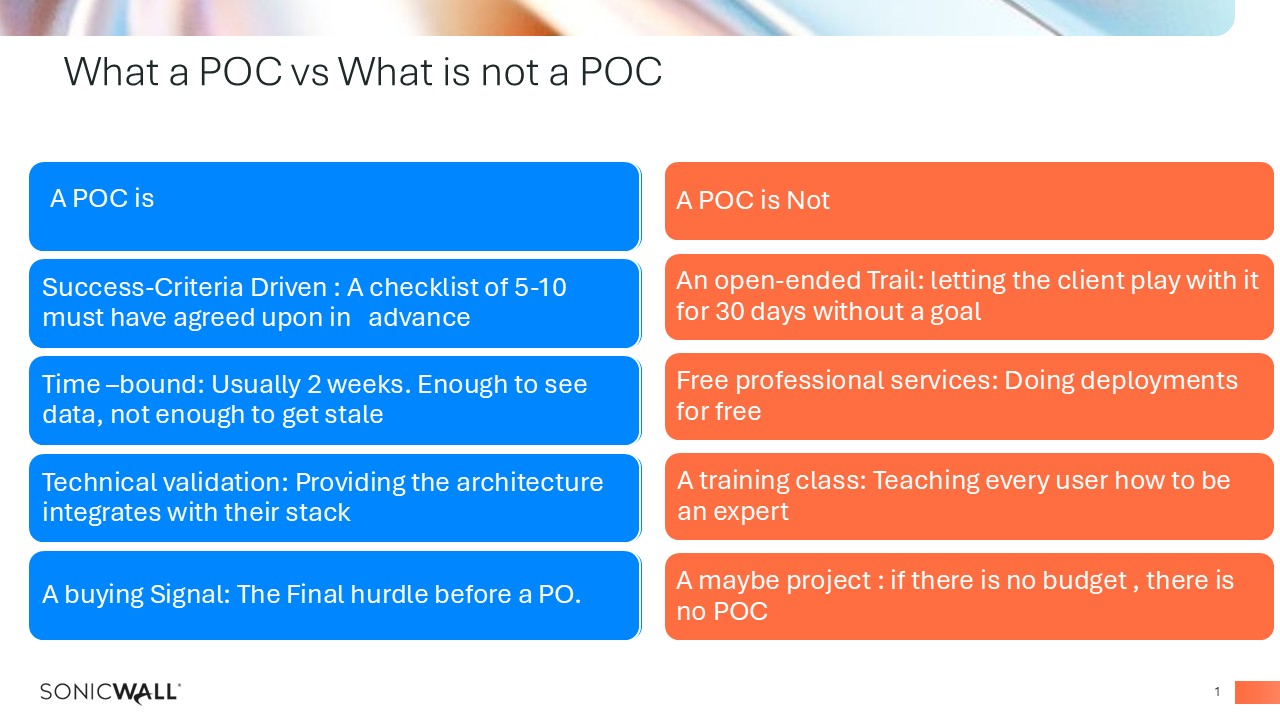
Here's my non-negotiable rule: if there's no success criteria document, there's no POC. Full stop.
A POC is the most expensive investment in your sales cycle — in terms of your time, your SE's time and your customer's goodwill. It is not a free trial. It is not "just let us play with it for a month." It is a structured validation exercise with a start date, an end date and a clearly defined "Definition of Done" that leads directly to a purchase order.
.jpeg)
If a customer can't tell you what five to 10 specific criteria they need to see met in order to move forward, they're not ready for a POC. They have a curiosity problem, not a buying problem.
What a proper POC actually looks like:
A success document — signed and agreed upon before anything goes live. It should state clearly: "If the tool demonstrates X, Y and Z in our environment within the agreed timeframe, we will move to procurement." This protects both sides and keeps the engagement honest.
A defined threat or problem to test against. Are you validating a specific compliance gap? A particular attack vector? A workflow replacement? Ambiguity here is how POCs drift and die.
A weekly sync — every week, same time, 30 minutes. Review what was tested, check criteria off the list, identify blockers. Don't let the POC go dark. The moment there's silence for two weeks, you've lost control of the timeline.
An executive summary at the end. Not a 40-page technical log — a three-slide deck for the decision maker that shows, in plain language, what threats were caught that their current tools missed, and what that means for their risk posture and ROI. This is how you justify the budget to the people signing the check.
Red Flags That Should Make You Pause
Not every "POC opportunity" deserves one. Part of being a trusted advisor is knowing when to pump the brakes.
"We just want to play with it for a while."
This one sounds reasonable but usually isn't. What it often means is: we don't have a specific problem to solve, or the champion doesn't actually have internal buy-in for this project yet. Left unchecked, this becomes POC purgatory — six months of low-priority testing with no decision at the end.
"Can we test 50 different use cases?"
This is analysis paralysis dressed up as thoroughness. A customer trying to cover 50 use cases is usually a customer looking for a reason to say no — or one that hasn't aligned internally on what actually matters. Your job here is to help them narrow it to the top three business risks and build the POC around those.
Here's a harder truth: if the customer won't commit to a closing meeting after the POC, don't start the POC. It sounds blunt, but your time is the most valuable asset in your practice. Protect it by only going deep with customers who are genuinely ready to solve a problem.
We've Done the Heavy Lifting — Use It
One more thing worth mentioning: our SE and SA teams have built out global POC engagement templates across multiple product lines specifically to help partners run tighter, faster, more credible technical validations.
These aren't rigid documents. Think of them as a structured starting point — a framework you can tailor to each customer's environment and success criteria. They're designed to help you walk in with credibility, run a cleaner engagement, and walk out with a signature.
If you haven't reviewed them yet, that's the first thing to do after this.
The Bottom Line
The partners who consistently win in technical validation aren't necessarily the ones with the most technical expertise. They're the ones who are the most disciplined about when to demo, how to structure a POC, and when to walk away from an engagement that was never going to close.
A great demo earns you the right to a POC. A great POC earns you the right to a purchase order. The path between them is shorter than most people think — if you don't let it get complicated.
Be the trusted advisor in the room. Know which tool you're holding, and use it with intention.
Call to Action: Questions? Want to review the POC engagement templates or talk through a specific customer scenario? Reach out to your SonicWall sales team — that's exactly what we're here for.
Share This Article

An Article By
An Article By
Rajesh Agnihotri
Rajesh Agnihotri