
Beyond the CVE: Why Secure by Design and Automated Patching Are Redefining Protection
by Asif Mujtaba

CVE count does not measure security. Remediation speed, patch adoption, and Secure by Design practices do.
When a new CVE (Common Vulnerabilities and Exposures) is published, the headline almost always focuses on the vulnerability itself. For customers, partners, and Managed Service Providers (MSPs), it is tempting to read that headline as a verdict: the product failed, or the vendor fell short.
The opposite is usually true.
A disclosed CVE is most often a sign that the cybersecurity ecosystem is functioning exactly as it should. Researchers surface a potential issue, the vendor investigates and remediates it, and customers receive an update that strengthens their environment. The discovery of a vulnerability is not the danger. The danger is a known vulnerability that remains unpatched long after a fix is available.
That distinction changes everything about how security should be measured.
The Industry Is Having the Wrong Conversation
No software vendor is immune to vulnerabilities. A modern security platform spans millions of lines of code, integrates with cloud services, supports thousands of deployment scenarios, and evolves continuously to meet new threats. Vulnerabilities are an inevitable byproduct of building software that does meaningful work.
So, the question that matters is not "Does this vendor have CVEs?" Every serious vendor does.
The questions that separate a strong security posture from a weak one are:
Dimension | Key Question | SonicWall Approach |
| Speed of Discovery | How quickly are vulnerabilities identified? | Researchers, internal testing, automated scanning |
| Transparency | How openly does the vendor communicate? | Public advisories, coordinated disclosure, clear timelines |
| Remediation Velocity | How rapidly are fixes developed and released? | Coordinated process across Product Security, Engineering, QA, Support |
| Ease of Deployment | How simply can customers apply fixes? | Critical Upgrade Channel, automated firmware updates via NSM |
| Operational Burden | How much weight is placed on IT and MSPs? | Automated patch management; 140,000+ firewalls upgraded at 99.9% success |
A vendor's CVE count tells you very little. The answers to these five questions tell you almost everything.
Secure by Design Is Reshaping the Industry
Government agencies and security leaders are converging on a more accountable model known as Secure by Design. Championed by the U.S. Cybersecurity and Infrastructure Security Agency (CISA) and aligned with guidance from the National Institute of Standards and Technology (NIST), the principle shifts responsibility away from the customer and onto the vendor. Rather than expecting every organization to harden every deployment by hand, vendors are expected to ship products that are secure by default, resilient by design, and straightforward to maintain.
In practice, Secure by Design means the following:
Secure by Design Principle | SonicWall Implementation |
| Secure Default Configurations | Ships hardened; no insecure out-of-the-box settings |
| Rapid Vulnerability Remediation | Coordinated patch process; Critical Upgrade Channel |
| Reduced Operational Complexity | Automated firmware management via NSM |
| Strong Authentication Controls | MFA enforcement, login rate limiting, account protection |
| Continuous Product Improvement | Auto-rollback, ongoing secure configuration defaults |
The objective is straightforward to state and demanding to deliver: make it easier for customers to stay secure.
How SonicWall Manages Vulnerabilities
At SonicWall, vulnerability management is treated as a continuous commitment rather than a reactive scramble. When an issue is reported through researchers, customers, security programs, or internal testing, SonicWall's Product Security, Engineering, QA, and Support teams move through a coordinated process:
- Validate the reported issue
- Assess severity and potential impact
- Develop and rigorously test the fix
- Communicate clear guidance to customers and partners
- Deliver the update as quickly and as safely as possible
The result is remediation that is fast without being reckless, preserving the reliability that customers depend on while closing the window of exposure. Transparency, responsiveness, and customer protection sit at the center of every advisory.
The Real Challenge Is the Patch Gap
Key InsightThe hardest problem in modern cybersecurity is no longer creating a patch. It is getting that patch adopted. Attackers consistently favor known vulnerabilities: flaws for which a fix already exists but has not yet been applied. |
The obstacles to adoption are familiar to every IT team:
- Limited staff and time
- Narrow maintenance windows
- Geographically distributed environments
- Large and varied device inventories
- Legitimate concerns about downtime
For an MSP managing hundreds or thousands of firewalls across many customers, those obstacles multiply. Every day a patch remains unapplied is another day of unnecessary exposure. Shrinking that window is one of the most effective security improvements any organization can make.
Making Security Easier Through Automation
Reducing the burden on administrators is a foundational principle of Secure by Design, and it is where automation earns its value. SonicWall has invested in automated firmware management and upgrade capabilities built to simplify patch deployment at scale.
Instead of relying solely on manual effort, organizations can use SonicWall's upgrade channels to receive critical firmware updates in a controlled and predictable way. The benefits compound across an environment:
- Reduced vulnerability exposure
- Improved operational efficiency
- Simplified compliance
- Lower administrative overhead
- A consistent security posture across every deployment
Most importantly, automation helps organizations become protected faster, and speed is the whole point.
Real-World Results at Scale
Proven at ScaleWhen SonicOS 7.3.2 and SonicOS 8.2.0 were released through SonicWall's Critical Upgrade Channel, more than 140,000 firewalls were successfully upgraded at a 99.9% upgrade success rate. |
For MSPs, that means fewer manual upgrade projects, less maintenance overhead, and stronger security outcomes delivered across the customer base. For customers, it means receiving critical protections sooner and with greater confidence.
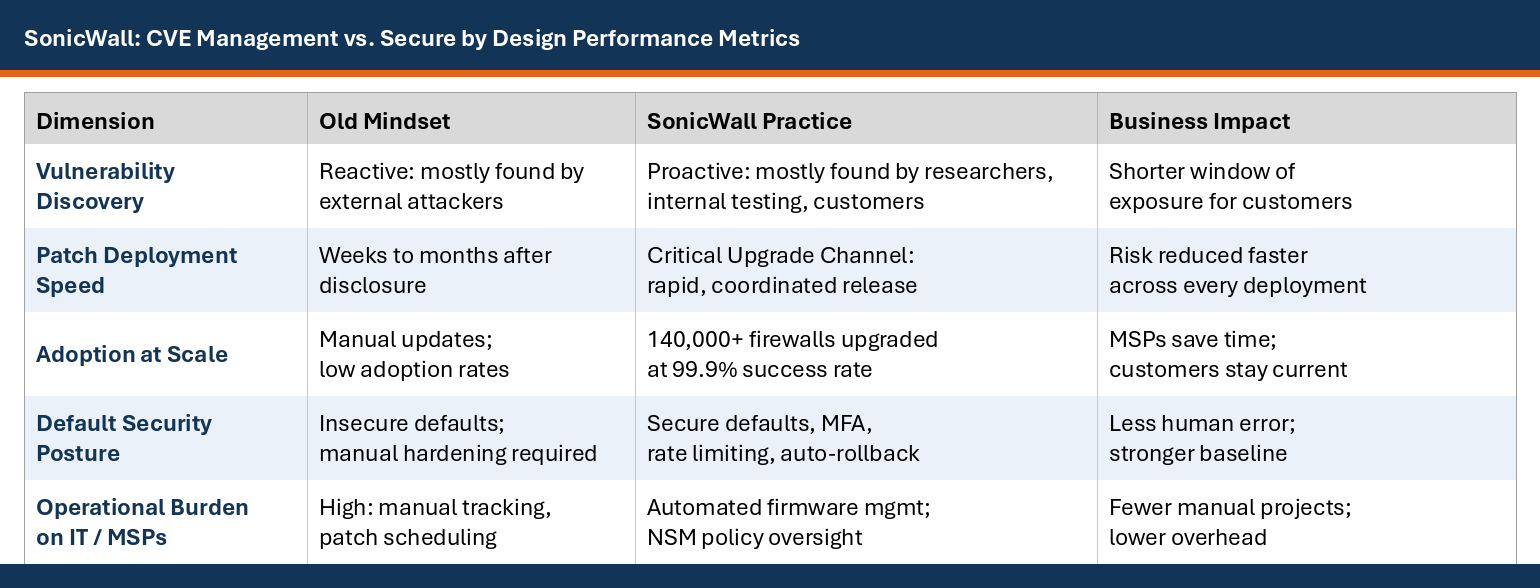
SonicWall: CVE Management vs. Secure by Design Performance Metrics
Secure by Design in Action
SonicWall's Secure by Design strategy reaches well beyond automated upgrades. Recent initiatives include:
- Security services enabled by default
- Strong password policies enabled by default
- Login rate limiting and account protection mechanisms
- Auto-rollback capabilities that reduce upgrade risk
- Continuous vulnerability management processes
- Ongoing investment in secure configuration defaults
Each enhancement is designed toward the same goal: stronger security outcomes without added administrative complexity. The most effective security control, after all, is the one that is actually deployed and actively protecting the customer.
Measuring What Matters
In today's threat landscape, security should not be judged by the number of CVEs a vendor reports. It should be judged by performance across the dimensions that determine real-world risk:
- How quickly vulnerabilities are discovered
- How transparently they are communicated
- How rapidly fixes are delivered
- How effectively customers can deploy those fixes
Organizations that shorten the distance between disclosure and remediation are far better positioned to withstand modern attacks.
Looking Ahead
Cybersecurity will keep evolving. New vulnerabilities will surface, new attack techniques will emerge, and new defenses will follow. What will not change is the need for transparency, rapid response, and customer-focused security practices.
At SonicWall, Secure by Design is more than an industry initiative. It is a commitment to helping customers, partners, and MSPs stay protected with less complexity and greater confidence.
Because the best security update is not the one that is available. It is the one that is already installed.
Conclusion
Measuring security by CVE count alone is a flawed approach that punishes transparency and misses the metrics that matter. The real indicators of a strong security posture are speed of discovery, quality of disclosure, remediation velocity, and ease of deployment at scale.
SonicWall's Secure by Design commitment, combined with automated patching infrastructure and a proven track record of large-scale upgrades, directly addresses the hardest problem in modern cybersecurity: closing the patch gap before attackers can exploit it.
SonicWall Takeaway More than 140,000 firewalls upgraded. A 99.9% success rate. Automated firmware management through NSM. Secure defaults across every platform. That is what Secure by Design looks like in practice. |
Frequently Asked Questions
| Question | Answer |
| Does a high CVE count mean a product is insecure? | Not necessarily. CVE count reflects disclosure activity, not product quality. Vendors that disclose more are often more transparent. What matters is remediation speed and patch adoption. |
| What is Secure by Design? | A framework championed by CISA and NIST that shifts security responsibility to vendors. It requires secure default settings, rapid patching, reduced complexity, and automated security maintenance. |
| How does SonicWall deploy patches at scale? | Through the Critical Upgrade Channel and automated firmware management in NSM, SonicWall has upgraded more than 140,000 firewalls with a 99.9% success rate. |
| What is the patch gap, and why does it matter? | The patch gap is the time between a fix being available and a fix being deployed. Attackers frequently exploit known, unpatched vulnerabilities, so shortening this window is one of the highest-impact security improvements an organization can make. |
| How does SonicWall reduce operational burden for MSPs? | Automated firmware upgrades, NSM-based policy oversight, and the Critical Upgrade Channel reduce manual effort, minimize maintenance windows, and deliver consistent security outcomes across large device inventories. |
For more information on Secure by Design
Check out CISA Secure by Design Guidance
Learn about NIST Cybersecurity Framework
Read about: Secure by Default: Moving Beyond Secure by Design
Share This Article

An Article By
An Article By
Asif Mujtaba
Product Manager
Asif Mujtaba
Product Manager

