
AI in Security and the Security of AI: Balancing Innovation and Resilience

A New Frontier in Cyber Defense
Introduction
Artificial intelligence is already a commonplace reality rather than a future idea. AI is changing how we operate, make decisions, and protect against evolving cyber threats across industries. However, despite its great potential, there are also significant risks.
As organizations embrace AI to accelerate innovation and productivity, one question stands above all:
How do we harness AI's potential — securely and responsibly?
The Situation: Promise and Paradox
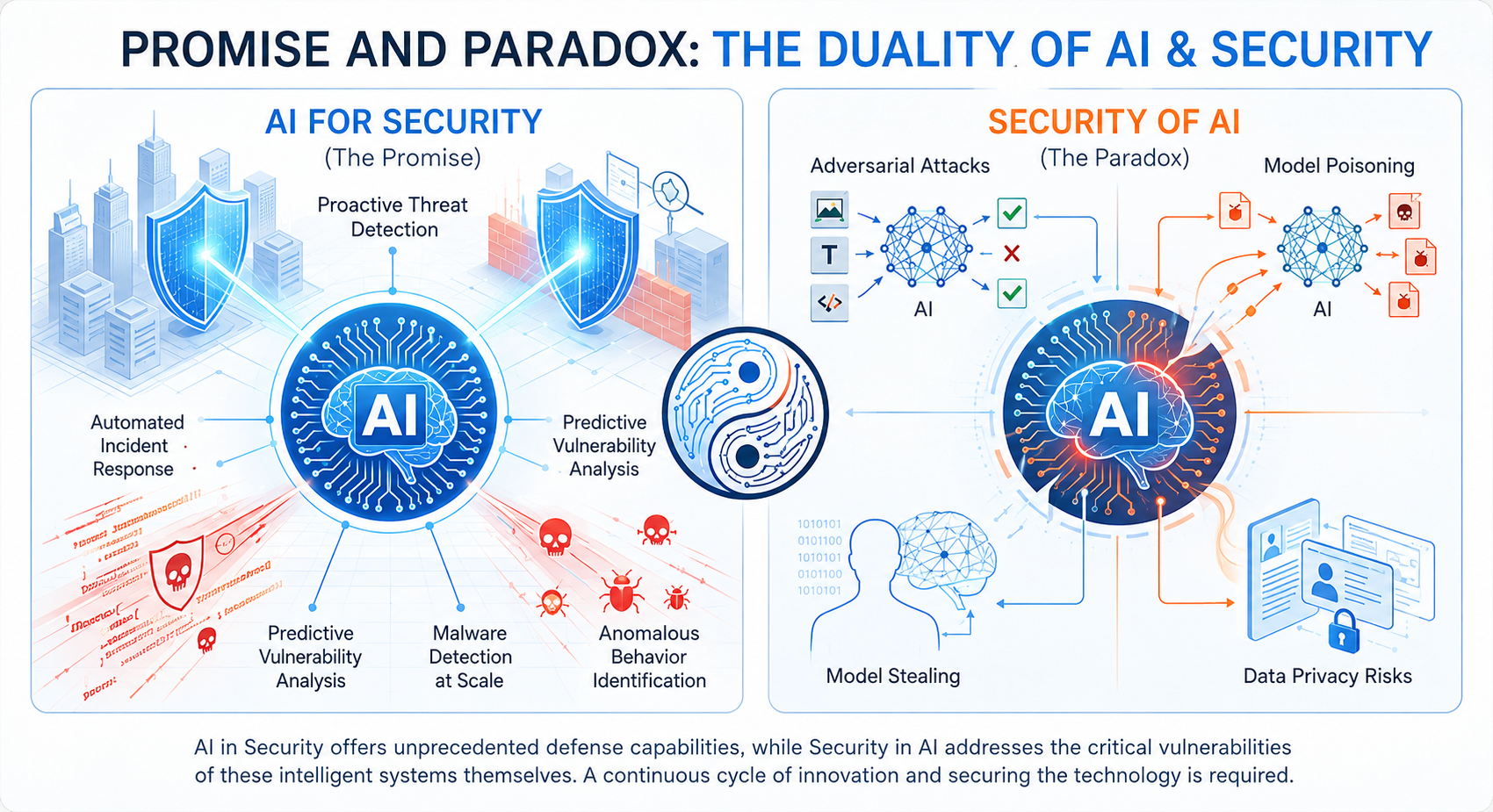
AI is here to stay. It is intricately linked to every aspect of business operations, including cybersecurity, consumer interaction, and predictive analytics. However, the rush to integrate AI frequently surpasses risk management, governance, and oversight.
Regulation and policy are often unable to keep pace with rapid technological advancements. Security professionals are frequently left to retrofit compliance and controls into systems that were never designed to be protected. The outcome is a paradox: unparalleled exposure combined with extraordinary opportunity.
The Good: Defending at New Speed and Scale
AI has already proven to be a powerful ally in strengthening cyber defenses. It can:
- Detect threats and anomalies faster than any human analyst.
- Automate incident response, patch deployment, and threat hunting.
- Improve data loss prevention and risk-based prioritization.
- Empower analysts to focus on complex problems instead of repetitive tasks.
The outcome is not just faster detection: it is smarter defense. AI augments human expertise, helping teams anticipate risks before they materialize and respond with precision when they do.
The Bad: When Innovation Moves Faster Than Security
With every new wave of technology comes a shadow of risk. AI features that streamline workflows can also be misconfigured or misused:
- Employees using public AI tools may unintentionally expose sensitive data.
- Unvetted AI applications can expand the attack surface.
- Lack of clear governance can lead to dangerous AI behaviors, including Shadow AI.
The risk associated with using AI poses a greater threat than the technology itself when guardrails are absent. The pressure for speed and innovation can undermine the very safeguards we rely on to stay protected.
The Rise of Adversarial AI
Threat actors are also evolving. Cybercriminals now use AI to create evasive malware, generate deepfakes, and launch realistic phishing operations. These attacks mimic human behavior, scale effectively, and bypass standard filters.
Defenders face a new challenge from an adversary that learns, adapts, and changes at machine speed. The focus of cybersecurity is shifting from protecting against tools to protecting against algorithms. The goal is to keep our defensive AI one step ahead, not simply to prevent AI-driven attacks.
The Balance: Responsible AI and Symbiosis
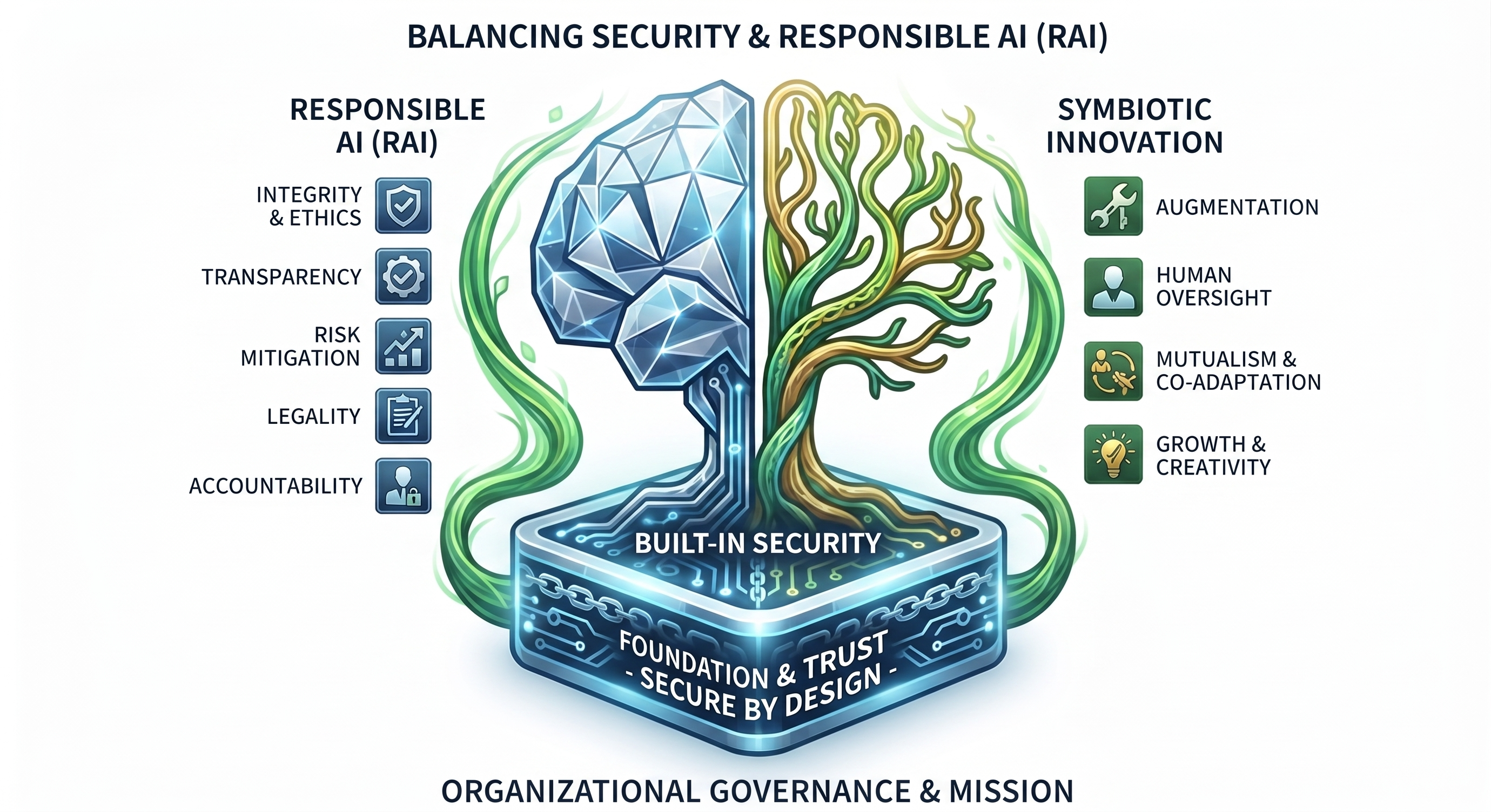
Choosing not to adopt AI is not a viable option. Recognizing the symbiosis between AI and security, a best-of-both approach is the optimal course of action. We need to embrace AI to increase defense, corporate efficiency, and productivity.
For this symbiosis to work, security must underpin AI as a foundational element, meaning it must be baked in from the start to avoid the cascade of downstream risks. Organizations must integrate AI governance into their missions and champion Responsible AI (RAI) principles that emphasize integrity, transparency, ethics, risk management, and legality. While innovating, businesses must also maintain focus on core cyber hygiene and actively prevent Shadow AI.
How SonicWall Is Leading Innovation with AI
AI in Threat Research and the Detection Engine
SonicWall leads in cybersecurity innovation by leveraging AI and machine learning across its protection platform. At the heart of this innovation is Real-Time Deep Memory Inspection (RTDMI), a patented method that analyzes code in memory rather than relying solely on traditional file-based scanning. This approach identifies highly evasive, zero-day malware that standard engines miss.
The Evolution of Deep Packet Inspection
SonicWall's AI heritage in threat detection stretches back more than two decades. In 2004, researchers at SonicWall Capture Labs began applying machine learning to threat analysis — well before AI became an industry buzzword. That foundational work produced one of the company's most consequential innovations: Reassembly-Free Deep Packet Inspection (RFDPI).
Traditional inspection engines required network traffic to be fully reassembled before scanning, creating latency and memory bottlenecks that limited throughput. RFDPI broke from that model entirely. By inspecting packets on the fly — without reassembly — SonicWall could block threats in real time while sustaining high throughput and eliminating memory constraints. The result was a fundamentally different approach to inspection: one that was faster, lighter, and more scalable than anything the industry had seen at the time.
That breakthrough changed both the speed and the effectiveness of advanced threat mitigation across the security industry. Over the following years, SonicWall deepened its machine learning capabilities and extended its AI-driven detection into the cloud. Today, the Capture Cloud Platform serves as the engine behind SonicWall's threat intelligence, continuously learning from global telemetry and pushing updated protections to every connected device.
The combination of two decades of domain expertise, purpose-built ML models, and cloud-scale intelligence allows SonicWall to move quickly when new threats emerge — extending protection to MSP partners and their customers faster than manual processes could ever allow. That commitment to ongoing AI innovation is what keeps SonicWall on the offensive in the cyber arms race rather than perpetually playing catch-up.
SAMI: SonicWall AI for Monitoring and Insight
Generative AI unlocks the ability for administrators to multiply their efforts in IT, network, and security management. MSPs are increasingly seeking ways to do more with less. SAMI (SonicWall AI for Monitoring and Insight) is an AI-powered assistant built into SonicWall Unified Management. Through a simple chat-based interface, MSPs can use SAMI to streamline repetitive tasks, gain actionable insights, and apply the latest best practices.
SonicWall AI Capabilities: A Structured Overview
Figure 1: SonicWall AI capabilities mapped to business impact for MSPs and enterprise security teams.
| Capability Area | What It Does | SonicWall Solution | Business Impact for MSPs |
| Threat Detection | Identifies unknown malware by inspecting code in memory | RTDMI: Real-Time Deep Memory Inspection (patented) | Zero-day protection before signatures exist |
| Packet Inspection | Scans network traffic without reassembly; blocks threats in real time | Reassembly-Free Deep Packet Inspection powered by ML | High throughput, low latency, no memory constraints |
| Threat Intelligence | Continuously updated, crowdsourced threat data | Capture Cloud Platform with ML-driven analysis | Always-current defenses; reduced manual research burden |
| AI Management Assistant | Natural-language interface for IT and security management | SAMI: SonicWall AI for Monitoring and Insight | MSPs do more with less; fewer repetitive manual tasks |
| Adversarial AI Defense | Counters AI-crafted malware, deepfakes, and phishing campaigns | Adaptive ML models that learn and update continuously | Stays ahead of evolving attacker algorithms |
Figure 2: SonicWall AI capabilities and MSP business impact summary.
Frequently Asked Questions
| Question | Answer | Confidence |
| What is AI in cybersecurity? | AI in cybersecurity uses machine learning and automation to detect, analyze, and respond to threats faster and more accurately than human teams alone. | High |
| How does SonicWall use AI? | SonicWall uses AI in RTDMI for zero-day detection, Reassembly-Free DPI for real-time packet analysis, and SAMI for intelligent management assistance. | High |
| What is RTDMI? | Real-Time Deep Memory Inspection (RTDMI) is SonicWall's patented technology that detects malware by inspecting code in memory, catching threats that bypass file-based scanning. | High |
| What is SAMI? | SAMI (SonicWall AI for Monitoring and Insight) is an AI-powered assistant embedded in SonicWall Unified Management that helps MSPs manage IT and security through a chat-based interface. | High |
| What is adversarial AI? | Adversarial AI refers to the use of artificial intelligence by threat actors to craft more evasive malware, generate deepfakes, and automate highly targeted phishing campaigns. | High |
| How do MSPs benefit from AI security tools? | MSPs benefit through reduced manual workload, automated threat detection and response, faster patch deployment, and AI-assisted management that scales with their client base. | High |
Conclusion
As cyber threats grow more sophisticated and unpredictable, the role of AI in cybersecurity has shifted from optional to essential. SonicWall's continued investments in AI-driven defense, including breakthroughs such as RTDMI for zero-day detection and SAMI for intelligent management, demonstrate a strong commitment to operational simplicity and security efficacy.
SonicWall is a cutting-edge, AI-powered security platform that helps businesses stay resilient and reduce risk. We welcome your questions and comments.
Ready to explore AI-powered security for your MSP practice? Visit sonicwall.com to learn more about RTDMI, SAMI, and the SonicWall Capture Cloud Platform. |
Share This Article

An Article By
An Article By
Rajesh Agnihotri
Rajesh Agnihotri

