
Key Trends and Drivers Shaping the Adoption of Virtual Firewalls

Why cloud migration, hybrid work, Zero Trust, and AI-driven threats are making virtual firewalls a baseline requirement for modern IT.
The firewall hasn’t gone away. It’s moved. As infrastructure migrates to the cloud, workforces distribute across every network imaginable, and attackers use AI to find gaps faster than any human can patch them, the question for IT teams is no longer whether to deploy virtual firewalls, it’s how quickly.
Here are the forces reshaping enterprise security architecture right now, and why virtual firewalls sit at the center of every serious response.
At a Glance: What’s Driving Adoption
Driver | Security Impact |
| Cloud Migration | Traditional perimeter firewalls lose visibility — virtual firewalls fill the gap |
| Hybrid Work | Distributed users expand the attack surface beyond what hardware can cover |
| Zero Trust / ZTNA | Granular segmentation and workload-level enforcement replace broad VPN access |
| AI-Driven Threats | Advanced threats require behavioral analysis, not static rule sets |
| Multi-Cloud Expansion | Consistent policy across providers demands software-defined control |
| Compliance Pressure | Auditors expect documented segmentation and traffic inspection in cloud environments |
The sections below unpack how the drivers are reshaping enterprise security architecture, starting with the shift that set everything else in motion: the move to the cloud.
1. Cloud Migration: Security Must Follow the Workload
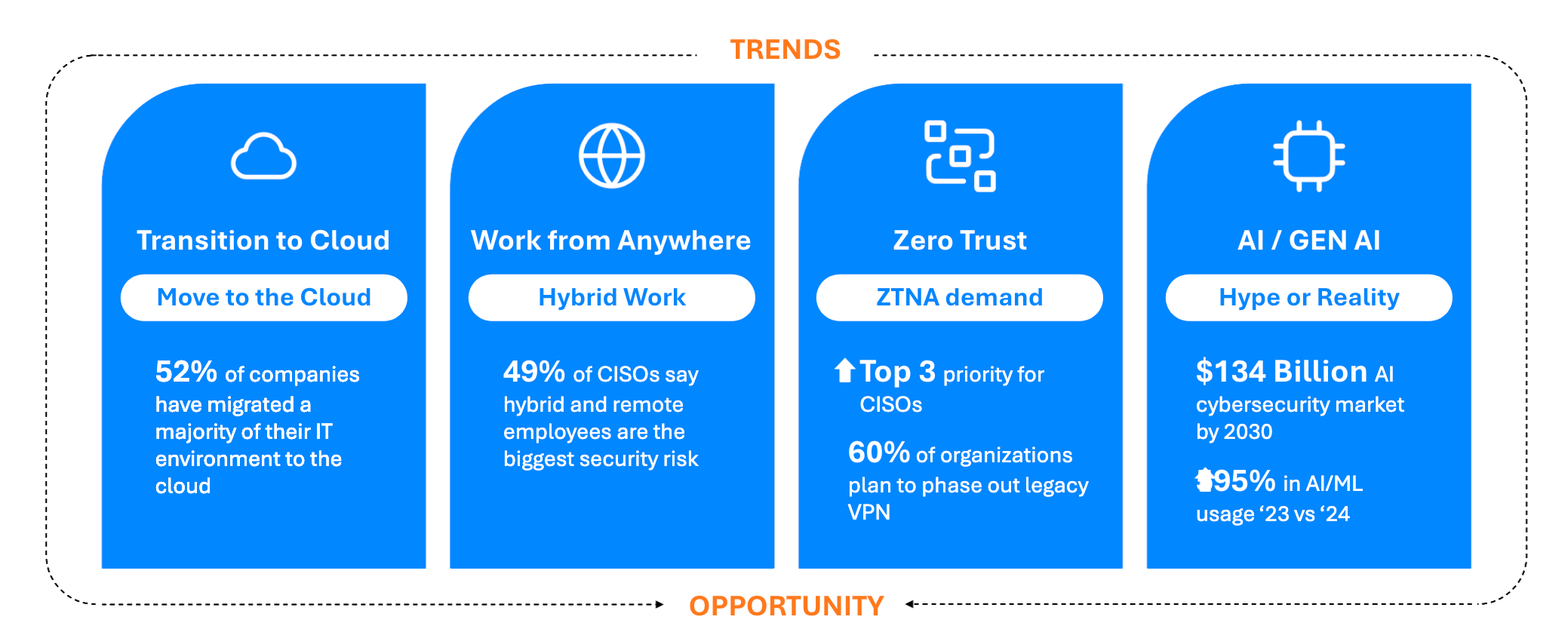
One of the strongest drivers behind virtual firewall adoption is the large-scale transition to cloud computing. Today, more than half of organizations have migrated the majority of their IT infrastructure from traditional on-premises data centers to cloud platforms.
That shift breaks traditional security models. Here is why:
- Workloads are distributed across multiple cloud environments
- Traditional perimeter-based firewalls lose visibility the moment traffic moves inside virtual networks
- East-west traffic between workloads never touches a physical appliance
- Infrastructure scales dynamically and security must scale with it
Virtual firewalls are purpose-built for this reality. They integrate directly into the cloud infrastructure, inspect east-west and north-south traffic, and enforce policies without depending on hardware that cannot keep up with the workload. As cloud adoption grows, so does the imperative to protect it at the workload level.
2. Hybrid Work: The Perimeter Is Everywhere Now
The corporate network boundary no longer exists in any meaningful sense. Hybrid and remote work have permanently altered enterprise network architecture. Nearly half of CISOs report that remote employees represent their single largest security risk, and the reasons are structural:
- Users connect from unmanaged home and public networks
- Devices operate entirely outside traditional perimeters
- Applications are accessed from anywhere, on any connection
- VPN-only models grant network access that is far too broad
This distributed workforce expands the attack surface in every direction. Virtual firewalls address this by securing cloud-hosted applications, enforcing application-level access controls, and protecting hybrid connectivity between remote users and corporate resources. The architecture scales with the workforce. Hardware cannot.
Hybrid work is not a temporary trend. It is a structural shift that demands a security infrastructure built for it.
3. Zero Trust and the Phase-Out of Legacy VPNs
Zero Trust Network Access (ZTNA) has become a top cybersecurity priority for security leaders across industries. At the same time, organizations are accelerating their exit from traditional Virtual Private Network (VPN) architectures in favor of more secure and adaptive access frameworks.
Legacy VPNs grant broad network access once a user authenticates. Zero Trust flips that model entirely: every access request is continuously verified (“never trust, always verify”), regardless of who the user is or where they are connecting from. Access to applications and resources is granted only after strict verification of identity, device posture, and contextual security policies.
Virtual firewalls are essential to executing a Zero Trust strategy:
- Enforcing granular segmentation policies across workloads
- Limiting lateral movement between application tiers
- Inspecting traffic at the workload level, not just the network edge
- Integrating with identity-aware access controls
Moving away from flat networks and legacy VPN models means rebuilding how access is granted and monitored. Virtual firewalls provide the enforcement layer that makes Zero Trust operational rather than theoretical.
4. AI-Powered Threats Demand Adaptive Defenses
Artificial intelligence is reshaping the threat landscape as fast as it is reshaping everything else. Attackers are not waiting for defenders to catch up.
Current trends in AI-driven attacks include:
- AI-generated phishing campaigns that defeat traditional detection
- Automated vulnerability discovery that compresses attacker timelines
- AI-assisted malware that adapts to evade static rule sets
- Rapid exploitation of cloud misconfigurations at scale
Recent incidents involving targeted attacks against major security vendors demonstrate the continuous evolution of adversarial techniques and tactics. The growing sophistication of AI-driven threat capabilities renders traditional static security controls increasingly inadequate for addressing modern attack patterns.
Virtual firewalls deliver advanced threat prevention, deep packet inspection, and behavioral analysis, built for dynamic environments. When adversaries are moving at machine speed, defenses need to operate the same way.
Additional Drivers Accelerating Adoption
Beyond the four primary trends, several other factors are influencing adoption:
Multi-Cloud Strategies
Most enterprises now operate across multiple cloud providers simultaneously. Maintaining consistent security policies across AWS, Azure, GCP, and private cloud environments is operationally impossible with hardware-based controls. Software-defined virtual firewalls provide the centralized policy layer that multi-cloud environments require.
Micro-Segmentation Requirements
Modern applications follow microservices architectures where individual services communicate laterally across a flat internal network. Virtual firewalls enable granular segmentation between application tiers, containing the blast radius of any breach and preventing attackers from moving freely through internal environments once they are inside.
Regulatory and Compliance Pressure
Industries handling sensitive data, for example, healthcare, financial services, and government, must demonstrate strong network segmentation and traffic inspection controls to auditors and regulators. Virtual firewalls provide the documented, verifiable controls that compliance frameworks require, even as the infrastructure they protect moves to the cloud.
Cost and Operational Efficiency
Software-based firewalls eliminate dependence on physical hardware, reduce maintenance overhead, and allow significantly faster deployment cycles. For SMB and mid-market IT teams managing lean budgets, this is not a minor consideration. Virtual firewalls deliver enterprise-grade protection without the enterprise-grade hardware cost.
The Bottom Line
Virtual firewall adoption is not driven by a single trend. It is the result of multiple converging forces arriving at the same time. Cloud migration, hybrid work, Zero Trust mandates, AI-powered threats, multi-cloud complexity, and compliance pressure are collectively dismantling the architectural assumptions on which traditional firewalls were built.
As IT environments become increasingly virtual and distributed, security must follow suit. Virtual firewalls provide the flexibility, scalability, and workload-level protection that modern infrastructure requires.
The question is no longer whether your organization needs virtual firewalls. The question is how quickly you can implement them effectively.
Take a test drive on a free 90-day NSv Trial
Learn more about SonicWall Virtual Firewall offerings
Share This Article

An Article By
An Article By
Lokesh Kannaiyan
Lokesh Kannaiyan

Leelin Thye
Senior Manager, Product Marketing
Leelin Thye
Senior Manager, Product Marketing

