
Alert-to-Ticket Is Here: SonicWall PSA Integrations Hub Just Got Smarter

Managing alerts with your PSA tool just got easier
If your team has ever lost time toggling between the SonicWall Unified Management platform (for SonicWall alerts) and your PSA platform to manually open, update, and close tickets, this announcement is for you. Alert-to-Ticket, the newest capability within SonicWall’s PSA Hub, is now generally available!
Why Alert-to-Ticket Matters
The PSA Integrations Hub has already been available to MSP partners, giving them automated accounting/billing and asset documentation between SonicWall products and their PSA platform of choice. Alert-to-Ticket is a new feature added to that same integration, extending it to cover alert-driven ticket creation as well.
Running an MSP means juggling ticketing, billing, and security across disconnected tools or hopping between portals. The PSA Integrations Hub — powered by MSPCentric — allows MSPs connect the PSA platform they already use directly with the SonicWall products they trust. This gives a connected workflow, with no workarounds or manual syncing required.
Alert-to-Ticket is the operational bridge between console detection and MSP remediation. It converts user-selectable alerts from SonicWall Unified Management into a prioritized, context-rich PSA ticket, eliminating manual handoff and data entry entirely, allowing your staff to stay focused on their ticket boards instead of portal hopping. Together with the existing PSA Hub capabilities, it further enhances how MSPs experience and get value from Unified Management.
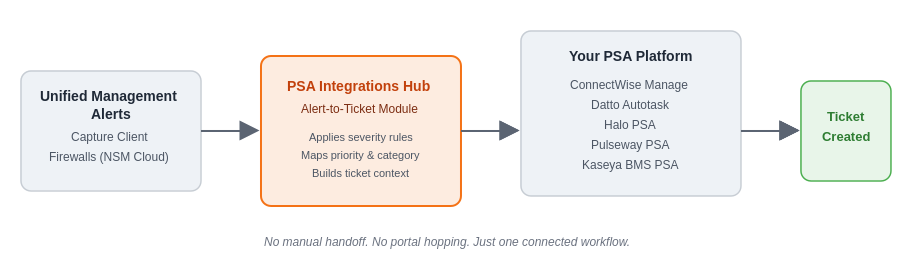
Alert-to-Ticket workflow: console alerts flow through the PSA Integrations Hub into a ticket on your PSA platform.
The Cost of Manual Ticketing
For MSPs still bridging alerts to tickets by hand, the operational drag adds up quickly:
- Creating a single ticket manually from an event can take 10–15 minutes of technician time, compared to near-instant automated creation.
- The context switching required to manually create tickets across disparate tools increases the likelihood that an alert could be missed.
- MSPs that automate the alert-to-ticket handoff have reported response-time improvements of up to 60%, along with far fewer missed alerts.
- Industry benchmarks place the average MSP cost per ticket between $15 and $50 for standard issues, with complex incidents costing considerably more.
- Foundational automations, including RMM/console-to-PSA ticket creation, typically drive 30–40% reductions in overall ticket volume.
- In one automation survey, 98% of firms pointed to disconnected tooling as a contributing factor in SLA breaches.
Sources: industry reporting on MSP automation platforms (Rev.io, LatestHackingNews, LTVplus); figures are illustrative benchmarks and will vary by MSP size and ticket mix.
Key Benefits
- Automated ticket creation — Capture Client alerts and Firewall alerts (managed via NSM cloud) generate tickets in your PSA platform without manual intervention. Additional products will be supported in future releases.
- Prioritized, context-rich tickets — Alert severity and detail carry through to the ticket automatically.
- Reduced response time — Technicians see relevant alerts in the tools they already use daily.
- Fewer dropped issues — Automatic logging reduces the risk of alerts slipping through the cracks.
.png)
The Alert-to-Ticket module in the PSA Integrations Hub, with rules enabled for Firewalls and Capture Clients.
Supported PSA Platforms
- ConnectWise Manage PSA
- Datto Autotask PSA
- Halo PSA
- Pulseway PSA
- Kaseya BMS PSA
Built for Flexibility
Alert-to-Ticket is not a one-size-fits-all switch. It is designed to adapt to how each MSP operates it’s service desk:
- Granular rule mapping — Create rules by product group (Firewalls and/or Capture Client) and alert type (Security, System, License), each mapped to its own service board, ticket priority, status, type, sub-category, and item type.
- Default plus custom rules — Start with a default rule that covers all alert types, then layer on specific rules as needed; rules are evaluated top-to-bottom, so partners control exactly which rule takes precedence.
- Editable anytime — Rules can be revisited and adjusted as ticketing needs evolve, without having to rebuild the integration.
- Test before you trust — A built-in test ticket function validates PSA API permissions and rule behavior before relying on it for live alerts.
- Full visibility — A dedicated Alert-to-Ticket view with a customizable, exportable table and an audit trail makes it easy to confirm which alerts became tickets, and to troubleshoot any that did not.
Getting Started
Alert-to-Ticket is available now within the PSA Integrations Hub on SonicWall Unified Management (Admin Settings → Third-party Integrations → PSA Hub). Partners can enable it directly from the Modules tab within PSA Hub.
.png)
The PSA Hub launch screen within SonicWall Unified Management Admin Settings.
For step-by-step setup instructions, including prerequisites, alert severity mapping, and PSA-specific permission guides, please refer to our detailed KB article: PSA Hub – Alert-to-Ticket Setup Guide.
For further questions, reach out to your SonicWall account representative or visit our partner support resources.
SonicWall Alert-to-Ticket connects your security stack to your service delivery platform, giving your team one less manual step and one more reason to trust the workflow.
Share This Article

An Article By
An Article By
Chandan Kumar Singh
Chandan Kumar Singh

