
Stateful vs. Stateless Firewall: What Is the Difference in Virtual Environments?

How Stateful and Stateless Inspection Shape Security in Cloud and Virtualized Architectures
Modern cloud and virtualized infrastructures require advanced network security mechanisms capable of inspecting, filtering, and controlling large volumes of traffic in real time. Virtual firewalls play a critical role in protecting these environments by monitoring data flows between workloads, applications, and external networks.
One of the most important architectural considerations in firewall technology is the difference between stateful and stateless traffic inspection. Understanding how these two approaches operate helps organizations design stronger security policies and choose the most suitable firewall configuration for their infrastructure.
Understanding Packet Inspection in Virtual Firewalls
Before exploring the differences, it is important to understand how virtual firewalls inspect network traffic.
Every communication across a network occurs through packets. A firewall analyzes these packets and decides whether to allow, block, or log the traffic based on predefined security rules. The method used to inspect these packets determines whether the firewall operates in a stateful or stateless manner.
What Is a Stateful Firewall?
A stateful firewall monitors the state of active network connections and maintains a dynamic state table that tracks ongoing sessions. Instead of inspecting packets in isolation, it evaluates packets in the context of an established connection.
For example, when a user initiates a connection to a web server, the firewall records session details. All subsequent packets belonging to that session are verified against the stored connection state.
Key Characteristics of Stateful Firewalls
Connection-Aware Inspection: Stateful firewalls track the full lifecycle of network connections.
Dynamic State Table: They maintain a table containing session information such as source and destination addresses, ports, and session status.
Improved Security Visibility: By analyzing traffic context, they can detect suspicious behavior and unauthorized session attempts.
Intelligent Packet Filtering: Packets are validated against active session states before being allowed through.
What Is a Stateless Firewall?
A stateless firewall evaluates each network packet independently without considering previous packets or the broader context of the connection.
It focuses only on basic packet attributes, such as:
- Source IP address
- Destination IP address
- Source port
- Destination port
- Protocol type (TCP, UDP, ICMP)
If a packet matches an allowed rule, it passes through the firewall. If it does not match the policy, it is blocked.
Key Characteristics of Stateless Firewalls
Packet-by-Packet Inspection: Each packet is analyzed individually without tracking connection state.
Faster Processing: Because no state table is maintained, processing overhead is significantly lower, enabling higher-speed traffic handling with minimal latency.
Simpler Rule Configuration: Policies are typically straightforward and based on network addresses and ports.
Suitable for High-Speed Traffic: Stateless filtering is well-suited to environments with high throughput requirements.
Limitations of Stateless Firewalls
Despite their speed, stateless firewalls have several limitations:
- They cannot detect complex attacks that span multiple packets.
- They lack awareness of session context.
- They are less effective in environments requiring deep inspection and advanced threat detection.
Stateful vs. Stateless Firewalls: Key Differences
The following table summarizes the primary distinctions between stateful and stateless firewall inspection in virtual environments.
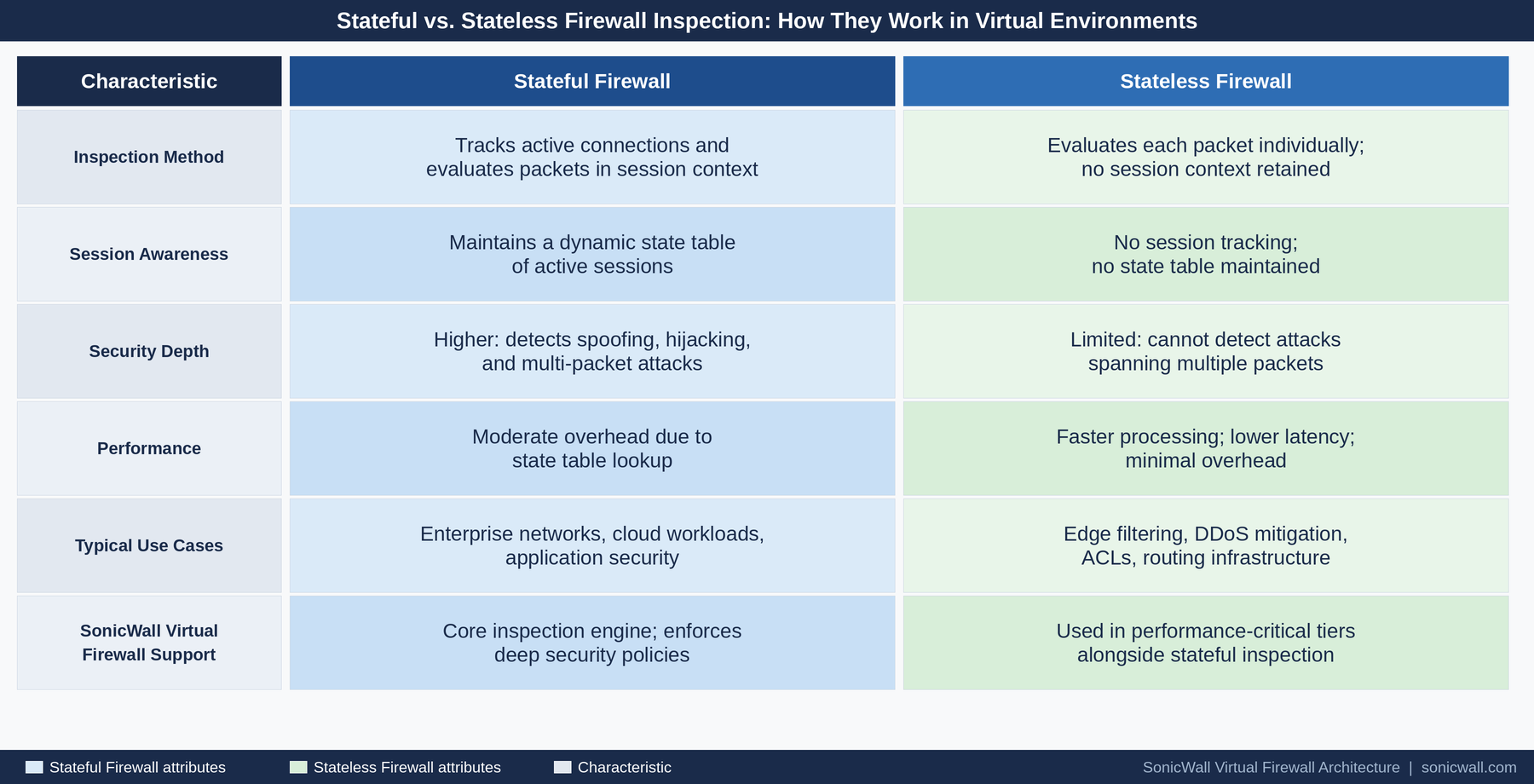
The differences outlined above are not merely technical distinctions. In practice, the choice of inspection method directly affects how well a virtual firewall can protect modern infrastructure. The following section examines why stateful inspection has become the dominant approach in virtualized environments.
Why Stateful Inspection Matters in Virtual Firewalls
Virtualized environments introduce complex traffic patterns, including east-west traffic between workloads and north-south traffic between external networks and applications. Stateful inspection enables virtual firewalls to analyze these interactions more effectively.
Key advantages include:
- Better detection of unauthorized sessions
- Protection against spoofing and session hijacking
- Enhanced application-layer awareness
- Improved visibility into workload communication
Because of these capabilities, most modern virtual firewalls rely heavily on stateful inspection as part of their core security architecture.
That said, stateful inspection is not the only tool available. While it excels at deep session analysis and threat detection, there are scenarios where its overhead is unnecessary and where a lighter approach delivers better results.
When Stateless Filtering Is Useful
Although stateful firewalls provide stronger security, stateless filtering plays an important role in specific scenarios.
Stateless inspection is commonly used for:
- High-speed packet filtering at the network edge
- DDoS mitigation layers
- Basic access control lists (ACLs)
- Network routing infrastructure
In many architectures, stateless filtering works alongside stateful inspection to balance performance and security.
Recognizing the complementary strengths of both approaches, many organizations choose not to rely on a single method. Instead, they deploy them together in layered architectures, applying each technique where it is most effective.
Hybrid Firewall Architectures in Virtual Environments
Modern virtual firewall platforms often combine both inspection models to optimize performance and security.
For example:
- Stateless filtering handles initial packet screening
- Stateful inspection analyzes application-level sessions
This layered approach allows organizations to maintain high throughput while enforcing deep security controls.
Understanding how these architectures work in practice is useful, but the more immediate question for most teams is how to determine which configuration is right for their specific environment.
How to Choose the Right Firewall Approach
Selecting between stateful and stateless inspection depends on several factors:
- Network traffic volume
- Security requirements
- Application sensitivity
- Infrastructure architecture
- Performance expectations
In most cloud and virtualized environments, stateful inspection provides the foundation for effective firewall protection, while stateless filtering enhances performance in high-speed environments. Organizations with mixed workloads often benefit most from a hybrid architecture that applies each method where it is best suited, scaling security depth in proportion to the sensitivity of the traffic being protected.
Conclusion
Stateful and stateless firewalls represent two fundamental approaches to traffic inspection within virtual firewall architecture. Stateless filtering provides speed and simplicity, while stateful inspection delivers deeper security visibility and stronger protection against sophisticated threats. A well-designed virtual security architecture often integrates both approaches in a hybrid model, applying stateless filtering at the perimeter for high-speed screening and stateful inspection at the session layer for contextual threat analysis.
Selecting the right approach depends on a careful evaluation of traffic volume, application sensitivity, security requirements, and infrastructure constraints. From our experience, organizations that rely on virtualized workloads benefit most from stateful inspection as their primary defense layer, complemented by stateless filtering where throughput demands require it. The goal is not to choose one method over the other, but to align each technique with the traffic tier where it delivers the greatest security value.
Frequently Asked Questions
What is the main difference between stateful and stateless firewalls?
A stateful firewall tracks active network sessions using a dynamic state table, evaluating each packet in the context of an established connection. A stateless firewall evaluates each packet in isolation based solely on source and destination attributes, without maintaining any session information.
Which firewall type provides better security?
Stateful firewalls generally provide stronger security because they can detect threats that span multiple packets, such as session hijacking and spoofing. However, stateless firewalls are faster and are well-suited for high-throughput edge filtering and DDoS mitigation.
Can virtual firewalls use both stateful and stateless inspection?
Yes. Modern virtual firewall architecture often implements both methods in a hybrid configuration. Stateless filtering handles initial packet screening at the perimeter, while stateful inspection performs deeper analysis of application-layer sessions. This combination balances performance and security.
Are SonicWall virtual firewalls stateful or stateless?
SonicWall virtual firewalls are built on a stateful deep packet inspection (DPI) engine. They provide advanced stateful inspection alongside additional security services such as intrusion prevention, gateway anti-virus, and application control, enabling comprehensive protection for cloud and virtualized environments.
Learn more:
Visit SonicWall NSv Series | Advanced Virtual Firewall Solutions
Try it: Start Free Trial
Share This Article

An Article By
An Article By
Lokesh Kannaiyan
Lokesh Kannaiyan

Leelin Thye
Senior Manager, Product Marketing
Leelin Thye
Senior Manager, Product Marketing

