
The Lights May Be Flashing, But the Patches Have Stopped: Gen 6 Firewalls Are Putting Your Whole Business at Risk

Gen 6 is entering End of Support (EOS), and it could be a hazard to your business.
“If the firewall’s lights are flashing and the internet works, everything is fine.”
That’s a reasonable assumption, because flashing lights and a working connection are the only indicators most people can see.
Generation 6 (Gen 6) SonicWall firewalls have reached End of Support (EOS). That means SonicWall will no longer release security updates for Gen 6 appliances. It does not matter how serious the next vulnerability turns out to be, even if it’s critical. Whatever is discovered tomorrow will still be open next year, on the device that sits between your business and the internet.
The stakes are not a slow connection or a dropped call. Your Gen 6 firewall has stopped getting security patches. The next critical vulnerability will stay open on the one device between your business and the internet, today, next year, and after that.
The risk is not downtime. It is a breach that can put your entire business in jeopardy.
What End of Support Looks Like On a Monday Morning
Imagine arriving at work to find your accounting system locked, your staff unable to log in and customers calling about orders you can’t see. Later in the day, your cyber insurer may ask a simple question: why was the business running a firewall that couldn’t be patched?
That is an illustration, not a prediction, and the pattern is real. Rarely does anything break on the day support ends. Most likely, the firewall keeps passing traffic and the lights will keep flashing. The trouble starts when someone finds a way through a gap that nobody can close.
Why Gen 6 End of Support is Different
Plenty of old hardware is a nuisance. Some of it makes loud noises, loads slowly or needs a good dusting. But Gen 6 isn’t just old. Gen 6 is a security problem. And it comes down to how fixes work.
When SonicWall finds a flaw in its firewalls, it publishes a public advisory and releases a patch. Supported firewalls can install it. Gen 6 firewalls can’t, because they no longer receive patches. The advisory still lists which products are affected, so anyone can read it, including attackers. Each new fix serves as a map for would-be threat actors, showing exactly which firewalls remain open.
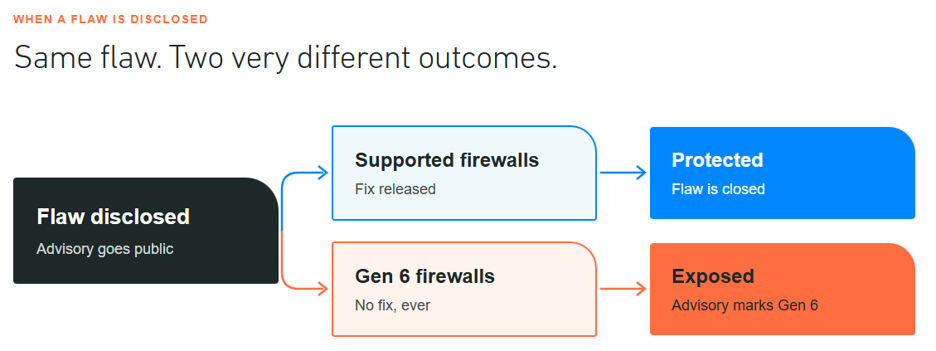
We’ve experienced this before. In 2024, a critical flaw tracked as CVE-2024-40766 affected Gen 5, Gen 6, and early Gen 7 firewalls and was added to the United States Government’s list of known exploited vulnerabilities. At that time, Gen 6 owners could simply patch it. Today, they could not.
A compromised firewall gives attackers a position inside your network, where they can steal credentials, move between systems and deploy ransomware. And SonicOS 8 has been hardened with frontier AI-assisted security testing, which SonicOS 6.x never received, meaning Gen 6 isn’t capable of running our most up-to-date protection software.
Attackers Are Moving Faster
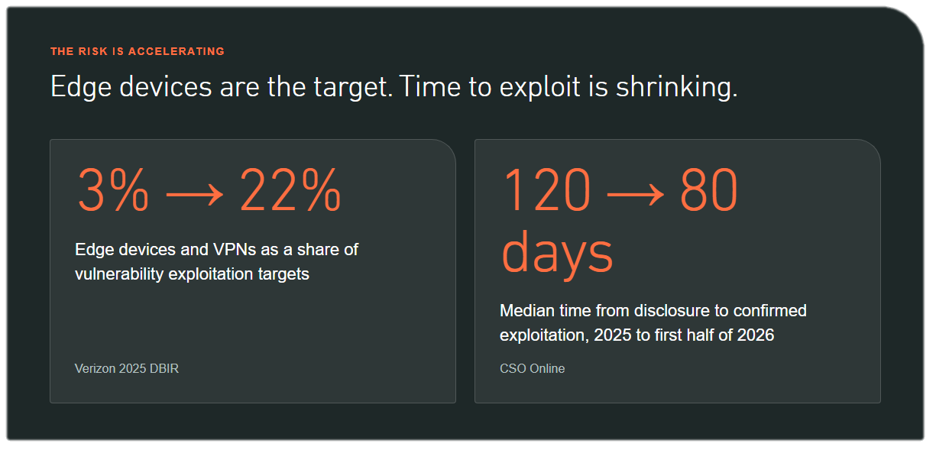
In one year, firewalls and VPNs went from a footnote to one of attackers’ favorite targets. Edge devices and VPNs accounted for 22% of vulnerability exploitation targets in Verizon’s 2025 breach report, up from 3% the year before. The gap between a flaw becoming public and someone using it has also shrunk, from a median of 120 days in 2025 to 80 days in the first half of 2026, with AI tools helping attackers write exploits faster. A patched firewall can keep up with that. Gen 6 can’t.
What a Breach Could Cost
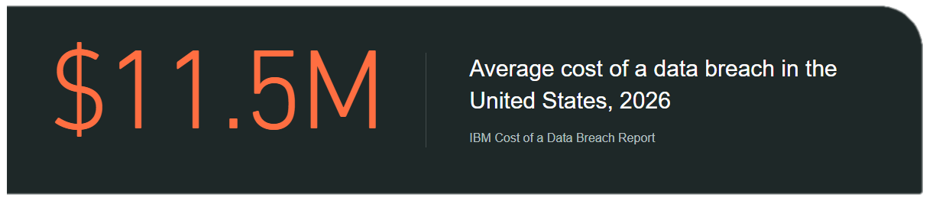
A breach through an unpatched firewall hits several parts of the business. Systems go down, orders and invoices stop. Customer and employee data gets exposed, which brings notification duties and customers who may not come back. Investigations, fines, contract penalties and lawsuits can follow. IBM’s 2026 research puts the average cost of a breach at nearly $5 million worldwide and $11.5 million in the U.S. Averages hide a lot, and your own number could be lower, but a fraction of that would still be serious for most small and midsize businesses.
Insurers, auditors and customers are paying attention as well. The U.S. government has ordered federal civilian agencies to remove unsupported edge devices such as firewalls, with deadlines of 12 to 18 months. That order covers federal agencies only, but it is reasonable to expect your own insurer or auditor to ask why a firewall that can never be patched is still protecting your network.
Replacing It Is More Manageable Than You Might Expect
Every Gen 6 model has a supported Gen 8 replacement running SonicOS 8. You don’t have to rebuild your configuration from scratch, because your existing settings can be carried over, either with the in-product import in SonicOS 8 or with the Migration App in Network Security Manager (NSM). Your authorized SonicWall partner can plan the migration with you and can tell you about current upgrade programs for Gen 6 customers.
What To Do Right Now
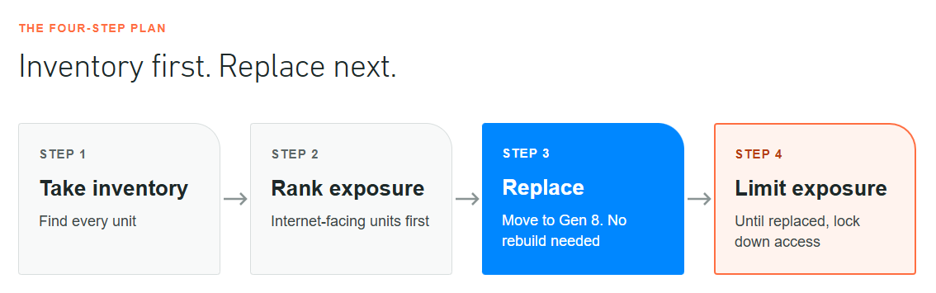
- This week, ask your partner or IT team for a list of every Gen 6 firewall, including spares and branch offices.
- Put the firewalls that face the internet or handle remote access at the top of the list.
- Schedule replacements with Gen 8, starting with those units.
- Until each one is replaced, switch off WAN management, switch off Secure Sockets Layer (SSL) VPN or limit it to known addresses, require multi-factor authentication on the remaining remote-access and admin accounts, and watch the logs. These steps lower the risk. They do not make an unsupported firewall secure.
Read our knowledge base article for more information.
The Bottom Line
Flashing lights tell you a firewall is running. They say nothing about whether it’s protecting you. The question is no longer whether your Gen 6 firewall will meet a threat it can’t handle. It’s how long you’re willing to run a security device that can never be fixed again. The next flaw will not be fixed. Every month a Gen 6 stays in place is another month for someone to find it, and your business is dependent on that firewall.
Call your authorized SonicWall partner and ask for the inventory this week or check the SonicWall Product Life Cycle tables for End of Support dates by model.
Share This Article

An Article By
An Article By
Jonathan Berger
Executive Vice President, Marketing
Jonathan Berger
Executive Vice President, Marketing
Jonathan Berger is the Executive Vice President of Marketing at SonicWall, where he leads the company's global corporate marketing team. With more than a decade of experience on the partner side of the business, including executive leadership roles at BlueAlly where he built and scaled a cybersecurity-focused VAR, MSP and MSSP, he brings a unique partner-first perspective. Jonathan believes that partner success and vendor success are inseparable, and that the strongest channel ecosystems are built on programs that deliver real business value.

