
Why Firewall Throughput Numbers Don’t Tell the Whole Story
Are you choosing a NGFW based on firewall throughput numbers? If so, it may be time to look deeper.
by Tiju Cherian

When choosing a new vehicle, most people consider fuel economy as one of their criteria. Now imagine a new car manufacturer began running ads stating their large SUV achieved 60 mpg (or 25.5 km/l, if you prefer).
That sounds pretty impressive, right? If you found out that that estimate was achieved in a in lab with no simulated wind resistance or road friction, using an engine bolted to a bare chassis — no seats, no upholstery, steering wheels, lights, etc. — you’d probably be much less excited, and rightly so!
Unlike with vehicles and the EPA, however, when it comes to firewalls, there is no one set standard for evaluation. Vendors use a variety of deployments and conditions to collect metrics, with one of the most frequently used in NGFW evaluations being “firewall throughput.”
Firewall Throughput vs. Threat Prevention Throughput
A next-generation firewall (NGFW) is a security device that protects an organization from external as well as internal threats, both known and zero-day. When choosing a firewall for an organization, it is essential to consider the expected network traffic volume and the required security features, ensuring that the selected firewall can handle the network's current and future demands effectively.
For this reason, a NGFW’s “stats” are often a crucial factor when choosing a NGFW vendor. But some are more useful to the decision-making process than others, as we see when we compare “firewall throughput” and “threat prevention throughput.”
Firewall throughput is the rate at which a stateful packet inspection (SPI) firewall can process and inspect network traffic while maintaining the stateful connection tracking information. SPI is a firewall technology that keeps track of the state of network connections and allows or denies traffic based on the context of those connections.
On the other hand, threat prevention throughput is the packet rate measured with all the security services like Intrusion Prevention (IPS), Anti-Virus, Anti-Spyware and Application Control turned ON.
(For best results, it is essential to actually check the threat inspection throughput, as opposed to just looking at the stated firewall throughput or threat inspection throughput numbers. Load testing and performance evaluations should also be performed to verify that the firewall's throughput meets your organization's requirements.)
How SonicWall Measures Up to Other Vendors Under Real-World Conditions
In situations in which other vendors’ threat prevention throughput numbers drop dramatically, SonicWall maintains its threat prevention throughput at a healthy number.
For instance, Vendor A’s threat prevention numbers dropped by 88% on their "Model B," compared to a drop of 63% on the SonicWall TZ270. Please see below table for more info:
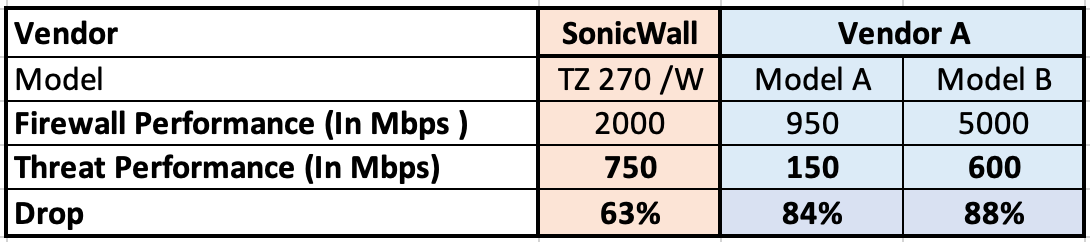 *Based on data publicly published by Vendor A, current as of 9/1/2023
Similarly, Vendor B's threat prevention numbers dropped by 96% on their "Model A," compared to a drop of 63% on a TZ270, as outlined in the table below:
 *Based on data publicly published by Vendor B, current as of 9/1/2023
How SonicWall Helps Solve Threat Inspection Requirements
Unlike other proxy-based firewalls, the SonicOS architecture is at the core of every SonicWall physical and virtual firewall, including the TZ, NSa, NSv and NSsp Series.
SonicOS leverages its patented, single-pass, low-latency, Reassembly-Free Deep Packet Inspection (RFDPI) and Real-Time Deep Memory Inspection (RTDMI™) technologies to deliver industry-validated high security effectiveness, SD-WAN, real-time visualization, high-speed virtual private networking (VPN) and other robust security features.
How Does Reassembly-Free Deep Packet Inspection® (RFDPI) Work?
Reassembly-Free Deep Packet Inspection (RFDPI) is a high-performance, proprietary inspection engine that performs stream-based, bi-directional traffic analysis. Best of all, it does so without proxying or buffering, to uncover intrusion attempts and malware and to identify application traffic regardless of port. This architecture includes:
- Bi-directional inspection
Scans for threats in both inbound and outbound traffic simultaneously to ensure that the network is not being used to distribute malware. It also ensures that the network does not become a launch platform for attacks in case an infected machine is brought inside.
- Stream-based inspection:
Proxy-less and non-buffering inspection technology provides ultra-low latency performance for deep-packet inspection of millions of simultaneous network streams without introducing file and stream size limitations. It can be applied on common protocols as well as raw TCP streams.
- Highly parallel and scalable single-pass inspection
The unique design of the RFDPI engine works with the multi-core architecture to provide high DPI throughput and extremely high new session establishment rates to deal with traffic spikes in demanding networks. A single-pass DPI architecture simultaneously scans for malware, intrusions and application identification, drastically reducing DPI latency and ensuring that all threat information is correlated in a single architecture.
How a Packet Passes Through a Competing NGFW with Proxy-Based Architecture vs. a SonicWall NGFW
The file limitations on other NGFWs can create dangers, because in some cases not all files are being scanned (see Fig. 1).
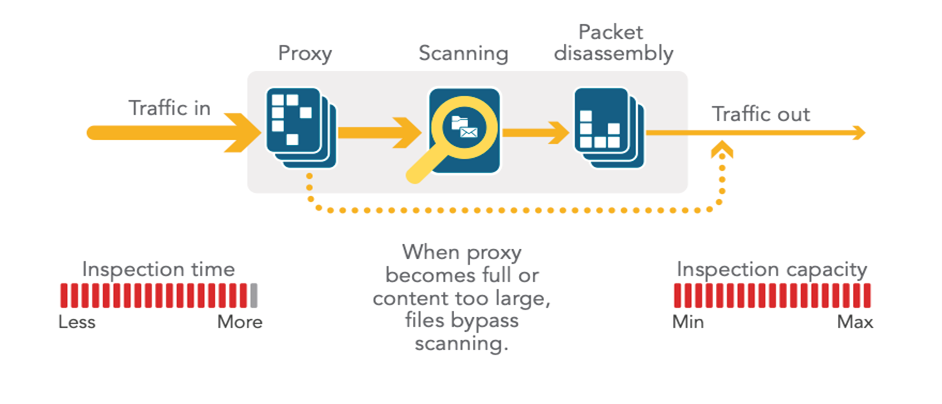
Fig.1
SonicWall's technology is designed to ensure files are scanned regardless of size (See Fig. 2).
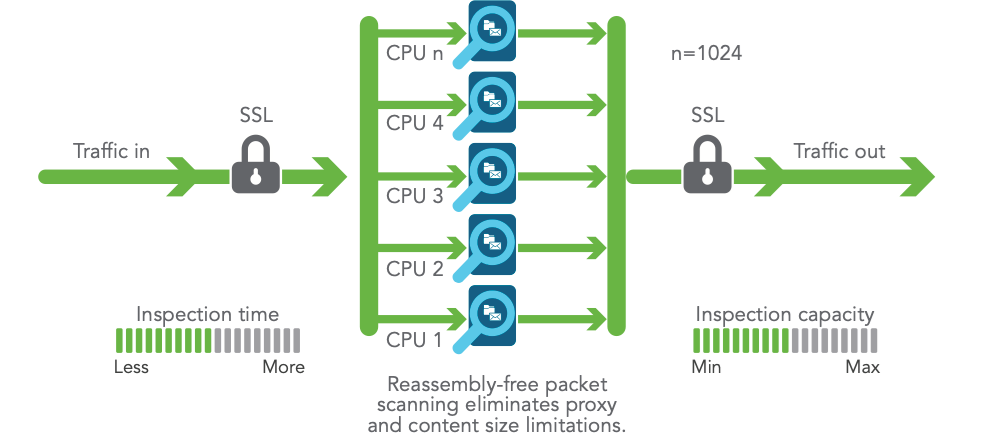
Fig.2
Read the tech brief on RFDPI to learn more about this stream-based inspection technology.
Conclusion
When evaluating firewall vendors, keep in mind the importance of evaluating threat performance with all the security services turned ON. Threat prevention for firewalls is essential to maintain continuous network protection and reduce the risks of potential security incidents. With SonicWall’s NGFWs, threat prevention is enabled and threat prevention throughput numbers are maintained without the huge drops seen with other vendors.
Share This Article

An Article By
An Article By
Tiju Cherian
Tiju Cherian


